· Atlas des Trésors
Vix treasure: a chip of red coral on the krater, perhaps "Medusa's blood", and the figurine's hand found
In the soil from the 1953 excavation, put back and then sieved again by Inrap, archaeologist Bastien Dubuis recovered some 2,000 fragments. Among them: a chip of coral that fits the handles of the famous Vix krater, and the fingers of the figurine on its lid.
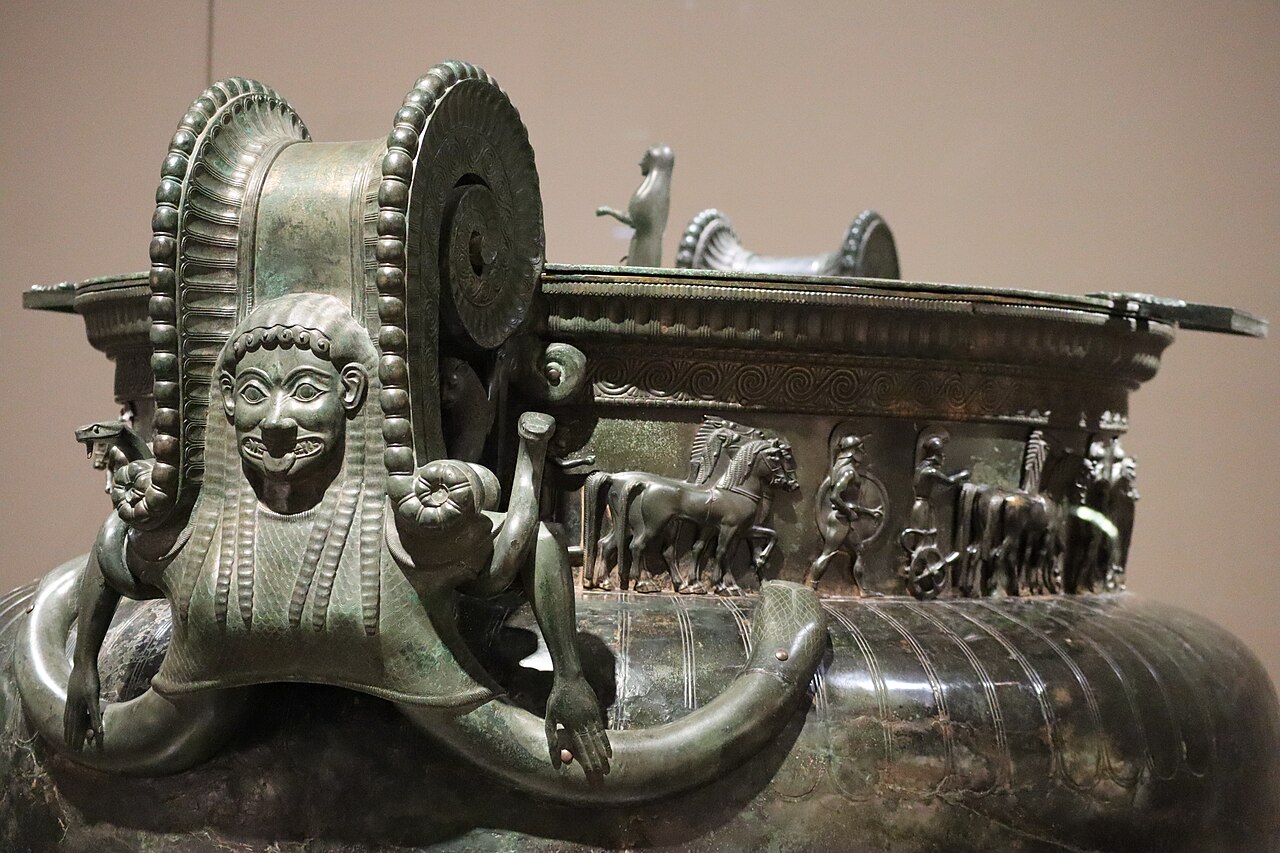
The tomb of the Lady of Vix, in Côte-d'Or, is one of the richest of Celtic Europe. It was thought to be fully known since its discovery in 1953, yet it keeps yielding surprises. In an article by Inrap, France's national institute for preventive archaeology, reported on 16 November 2026 by the website Arkeonews, archaeologist Bastien Dubuis presents the results of the study of the soil left on site after the first excavation: a small chip of coral, the fingers of a figurine, and evidence of trade as far as England.
A princely tomb at the foot of Mont Lassois
In January 1953, René Joffroy and Maurice Moisson discovered, at the foot of Mont Lassois, near Châtillon-sur-Seine, the burial chamber of a high-ranking woman who died about 2,500 years ago. She lay on the body of a chariot, with a gold torc and a drinking service. In the middle stood the Vix krater: a Greek bronze vessel about 1.64 metres high, weighing more than 200 kilos and able to hold some 1,100 litres. It is the largest bronze vessel known from antiquity. Each of its two handles bears a Gorgon, Medusa, the creature whose gaze turns people to stone.
In 2019, Inrap reopened the tomb. The aim was to study the funerary monument, and also to sieve the soil that the 1953 excavators had put back.
Two thousand forgotten fragments
According to Bastien Dubuis, about 72 bags of soil from the area dug in 1953 were passed through a 3-millimetre sieve. They yielded about 2,000 fragments: parts of the chariot, bronze nails, pieces of vessels and fibulae, the pins that fastened clothing. The number of fibulae known from the tomb rises from eight to sixteen.
At a press conference at the Musée du Pays Châtillonnais in early 2026, the archaeologist had already shown some of these objects: a sherd of Greek pottery, horse hooves that had fallen from the krater's frieze, and a piece of leg that fits a damaged horse.
Medusa's coral
The most unexpected piece is barely more than a centimetre across. It is a semicircular fragment of coral, now off-white but originally bright red. Each handle of the krater carries two large spirals with a round cavity at the centre. These four sockets were empty in 1953. The coral fragment fits them.
Bastien Dubuis suggests a hypothesis: this red coral may have stood for Medusa's petrified blood. In Greek mythology, as told notably by the Latin poet Ovid, the blood of the Gorgon beheaded by Perseus turns sea plants into coral. The archaeologist also links coral, blood and red wine. But nothing proves this reading. Analyses of krater fragments found pitch and traces of black grapes, with no fermentation marker, so wine is not attested there; residues associated with red wine were, however, found in the cauldron of the Lavau princely tomb, in the Aube.
An outstretched hand
The krater's lid is topped by a figurine of a woman, who was thought to be holding an object. A 7-millimetre bronze fragment with parallel grooves turned out to be part of the fingers of her left hand. Bastien Dubuis later found the missing thumb in the museum's storerooms. The figurine was in fact holding out both open hands, a gesture that could mean welcome, greeting or farewell.
Fixing marks and rivet holes also show that other figurines once stood on the lid and were deliberately removed. Why is unknown.
A later date and bracelets from England
The krater is dated to about 540 BC. Where it was made is still debated: workshops at Poseidonia, in southern Italy, or in northern Ionia, near Phocaea, in today's Turkey. If the eastern origin were confirmed, the figurine might evoke the priestess Aristarche, associated with the founding of Marseille. The archaeologist presents this only as a hypothesis.
Earlier studies dated the burial itself to around 500 BC. According to Bastien Dubuis, it did not take place before 470. Fragments of sapropelite bracelets, made of a black rock, come from the coast of Dorset, in England. Finally, DNA from one of the Lady's teeth shows she was neither the mother nor the grandmother of the prince buried at Lavau.
Where to see the Vix treasure
The krater, the gold torc and the grave goods are on display at the Musée du Pays Châtillonnais – Trésor de Vix, in Châtillon-sur-Seine. Our entry The Vix treasure tells the story of the discovery and gives visiting information.
Celtic tombs on the Atlas
Vix ranks among France's great treasures, alongside the Lavau princely tomb. Find the other sites of the region on our page Hidden treasures and legends in Burgundy-Franche-Comté.
Sources
- Arkeonews: Medusa's Blood May Solve the Mystery of a 2,500-Year-Old Celtic Princess's Tomb (16 November 2026)
- Inrap: La tombe de la Dame de Vix n'a pas dit son dernier mot (article cited on 16 November 2026 by Arkeonews)
- Châtillonnais en Bourgogne: Bastien Dubuis a présenté les objets découverts lors des nouvelles fouilles du tumulus de Vix en 2019 (6 March 2026)
- Wikipédia: Cratère de Vix (accessed 17 November 2026)
 Hungary: 208 Celtic silver coins found 40 cm underground, beneath a future power substation in Szombathely
 Sutton Hoo: a new Anglo-Saxon grave, with brooch, knife and tweezers, found far from the royal mounds
 Havmanden wreck: a luxury shoe and manillas on the Danish ship of the 1683 mutiny