· Atlas des Trésors
Sutton Hoo: a new Anglo-Saxon grave, with brooch, knife and tweezers, found far from the royal mounds
At Sutton Hoo, the site of the famous Anglo-Saxon ship burial, the Time Team crew and the National Trust excavated a cemetery away from the royal mounds in 2025. They found a "sand body" with its grave goods, and possibly a second burial beneath it. The results were revealed in November 2026.
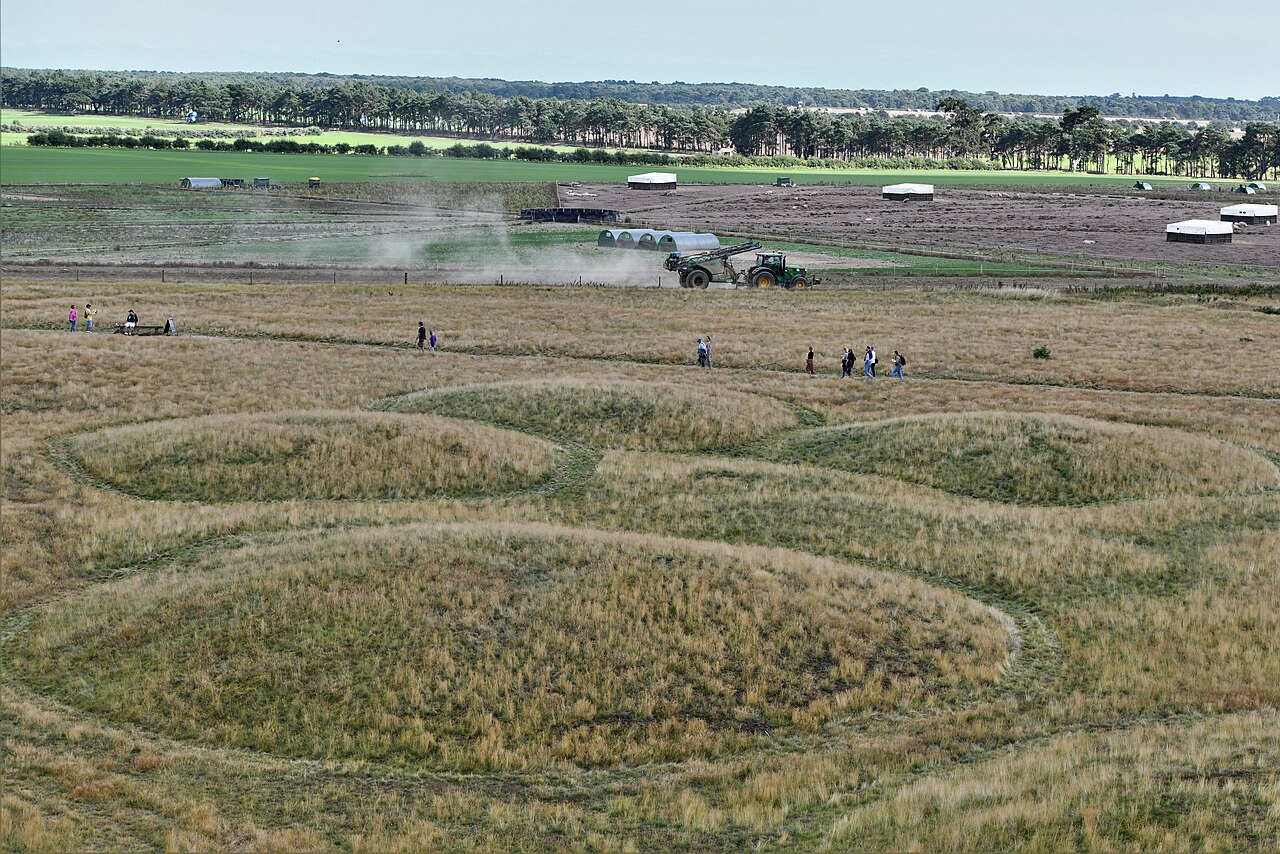
Sutton Hoo, in Suffolk, in the east of England, is famous for one of the richest Anglo-Saxon burials ever found: the ship burial uncovered in 1939, with its helmet, gold jewellery and garnets. The site still has more to say. The National Trust, which looks after it, and the team of the British archaeology programme Time Team have just presented the results of their 2025 excavations: a new Anglo-Saxon grave, away from the royal mounds.
A cemetery away from the kings
The excavations took place in Garden Field, a field on the estate that holds an Anglo-Saxon cemetery. Work began in 2024; in 2025, Time Team returned for a four-week dig.
"Until now archaeologists have focused on the royal burial mounds," explains Angus Wainwright, the National Trust's archaeologist. Attention, he says, is now turning to the wider community buried in the area.
A "sand body"
The grave appeared in the last week. The body has decayed: all that is left is a ghost-like shape in the sand, a darker imprint outlining the dead person. Such "sand bodies" are known at Sutton Hoo, where the acid soil destroys bone; examples had already been recorded in earlier excavations, notably in the 1980s.
The grave held objects: a brooch, a knife, tweezers and beads. Beneath this burial, the team found signs of a second person buried in the same grave. This is not yet confirmed, and nothing yet says whether the two were buried at the same time. Further excavation will be needed.
The Bromeswell Bucket
These excavations follow those of June 2024, carried out by Time Team, the National Trust, FAS Heritage and more than 80 volunteers. According to the National Trust, it was the most intensive excavation at Sutton Hoo since the 2000s. The team then lifted in a single block the base of the Bromeswell Bucket, a 6th-century Byzantine bucket. It turned out to be intact, holding a cremation and grave goods.
The burnt remains include parts of an ankle bone and a skull, as well as bones from an animal larger than a pig. Copper-alloy staining suggests the bones were originally in a bag. Fragments of the bucket had already been found in 1986 and 2012. "We were thrilled to finally locate and excavate the burial contained within the Byzantine 'Bromeswell Bucket'," says Helen Geake, Time Team's Anglo-Saxon specialist, adding that many questions remain.
A documentary series
The 2025 discoveries are the subject of a four-part documentary series. According to the National Trust, the first episode of Time Team's new season went online on YouTube on Saturday 14 November. Time Team is also running, with the Sutton Hoo Society, a large-scale geophysical survey of the royal burial ground.
Why Sutton Hoo matters
The ship burial in Mound 1, excavated in 1939 by the amateur archaeologist Basil Brown, is often attributed to King Rædwald of East Anglia, who died around 624, without definitive proof. Its grave goods, including the famous helmet, are kept at the British Museum in London. The site itself, with its mounds and visitor centre, is open to visitors.
Sutton Hoo on the Atlas
Our entry The Sutton Hoo treasure tells the story of the 1939 discovery and where to see the treasure. Other great Anglo-Saxon and Roman treasures from England are on the Atlas, such as the Staffordshire Hoard, the Hoxne Hoard and the Mildenhall Treasure. Find them all on our United Kingdom page.
 Hungary: 208 Celtic silver coins found 40 cm underground, beneath a future power substation in Szombathely
 Havmanden wreck: a luxury shoe and manillas on the Danish ship of the 1683 mutiny
 Vix treasure: a chip of red coral on the krater, perhaps "Medusa's blood", and the figurine's hand found