· Atlas des Trésors
Estonia: a Swedish queen, a sword and a piece of printing type emerge from a Tartu dig
Beneath the future Siuru cultural centre in the heart of Tartu, archaeologists uncovered in November a stove tile bearing the portrait of Queen Maria Eleonora of Sweden, a sword, a medieval knife and a tiny piece of printing type. The type may come from the very first printing press of the University of Tartu, founded in 1632.
In Tartu, Estonia's second city, a major archaeological dig has been exploring the ground beneath the future Siuru cultural centre since the spring. The city has published its report for the week of 2 to 6 November 2026, and it is a rich one: a stove tile bearing the portrait of Queen Maria Eleonora of Sweden, another showing a German duke, an iron sword, a medieval knife that still has its wooden handle and, above all, a metal printing type from the 17th century. The specialist site Arkeonews reported the finds on 13 November 2026.
A dig in the heart of the city
The excavation is run by the archaeology firm Arheox, with the Tartu City Museum (Tartu Linnamuuseum). A preliminary survey in 2024, with four test pits, confirmed a rich archaeological layer. The main excavation began in April 2026 and is due to last until the end of 2027.
The work goes deep. Once the ruins of recent buildings have been demolished and the foundations recorded, the archaeological layer appears about 2.5 metres below the surface. It is 1.6 to 2.5 metres thick and is dug by hand, down to about 5 metres. The archaeologists are focusing in particular on the old courtyards behind the houses.
The Queen of Sweden on a stove tile
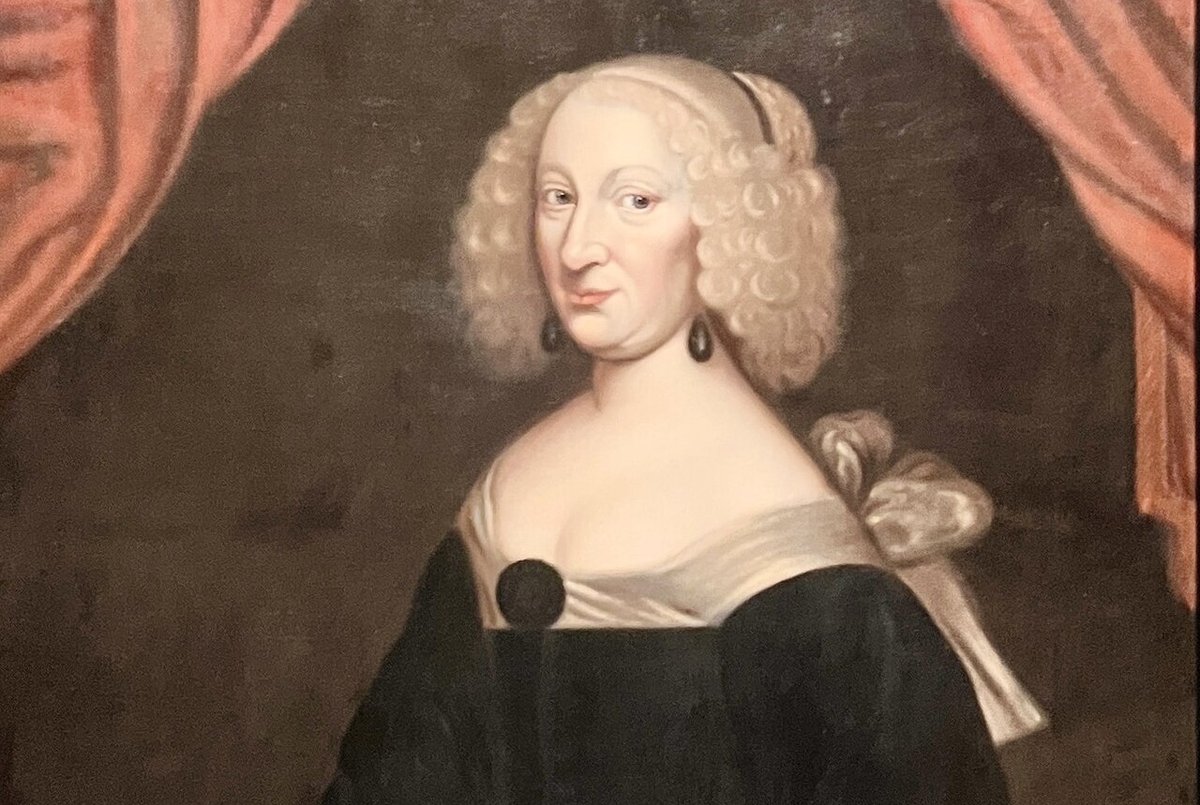
The most telling piece is a fragment of a green-glazed ceramic stove tile. It bears a relief portrait of Maria Eleonora of Brandenburg (1599-1655), wife of King Gustavus Adolphus of Sweden. It dates from the first half of the 17th century.
The portrait is no surprise in Tartu. The town, which the Germans called Dorpat, was then under Swedish rule, and it was Gustavus Adolphus himself who founded its university in 1632. In wealthy homes, the great tiled stoves were also a showcase, and the faces of rulers were a popular choice.
A second fragment, made in the same way, shows Duke John Albert II of Mecklenburg-Güstrow, a prince from northern Germany. Its date has not yet been determined. The researchers do not yet know which buildings the two tiles came from.
A sword, a knife and a puzzle
The dig also produced a heavily corroded iron sword with a long blade and a surviving hilt. Its date has not yet been established; study is under way. A small metal piece found nearby may be the tip of a scabbard or another cutting tool. Specialists consider it early modern or modern, but cannot yet link it to the sword.
More modest but rare, a medieval knife came out of the ground with its wooden handle. Wood survives badly: it needs damp, airless soil to last for centuries, which is what makes this site so interesting.
A letter from Tartu's first printing press?
The most unexpected find fits in the palm of a hand: a metal printing type about 6 millimetres high and 25 millimetres long. It carries an italic letter "h", raised and reversed, as on all type made for printing. Grooves helped the typesetter set it the right way round in the line.
According to Arvi Haak, head of archaeology at the Tartu City Museum, such letters were assembled one by one, by hand, in early modern printing houses. And this is a first: no type of this kind had previously been found in Estonian excavations.
Book historian Meelis Friedenthal, of the University of Tartu, puts forward an appealing hypothesis: the letter may come from the university's first printing press, which began work in 1632. He compared this italic "h" with the typefaces used in books printed in Tartu during the Swedish period. The earliest known Tartu imprint is a German text, the Postordnung by Jacob Becker, dated 28 September 1632.
The press had an eventful history. When Russian troops took Tartu in 1656, the university withdrew to Tallinn, but the printing equipment stayed in town. According to Arkeonews, it was hidden in a church and recovered when the university reopened. A letter lost in a courtyard could be a witness to those years. For now, it remains a hypothesis.
Months of discoveries
This week was not a one-off. According to the city, the site has already produced more than fifty medieval coins, including pieces struck in Tallinn and Tartu between the 1360s and 1420s, a cloth seal from Amsterdam, a goat-hair packing cloth linked to Hanseatic trade, a 16th-century pewter figurine, horse-shaped pendants from the 13th and 14th centuries, two iron trade bars and an amber bead. Tartu was a Hanseatic trading town, and its soil remembers it.
The coins will be cleaned, identified and analysed. For most of the other objects, the city has not yet said where they will be kept or whether they will be displayed.
Royal Sweden on the Atlas
The Sweden of Gustavus Adolphus left other treasures behind. On the Atlas, discover the Swedish regalia, the insignia of Swedish royal power, and all our content on Sweden.
 Hungary: 208 Celtic silver coins found 40 cm underground, beneath a future power substation in Szombathely
 Sutton Hoo: a new Anglo-Saxon grave, with brooch, knife and tweezers, found far from the royal mounds
 Havmanden wreck: a luxury shoe and manillas on the Danish ship of the 1683 mutiny