· Atlas des Trésors
Germany: five Roman bronze vessels, buried for 1,500 years, go on show for the first time in Schleswig
Spotted in late 2025 by Danish metal detectorists near Schaalby, in northern Germany, bronze cauldrons from the Roman world were lifted in a single block of soil, CT-scanned and then freed in the workshop. Archaeologists expected three; there are five, including a strainer. They have just been shown to the public for the first time.
A year after they were discovered, five bronze vessels around 1,500 years old have left the restoration workshop. Found near Schaalby, in the state of Schleswig-Holstein in the far north of Germany, they were shown to the public for the first time in November 2026, during the Archaeology Day held in Schleswig. HeritageDaily, drawing on the public broadcaster NDR, reported the news on 13 November 2026. The state archaeological office describes the find as exceptionally significant for the whole Baltic Sea region.
An "unpromising" signal
It all began in the late autumn of 2025. A group of Danish metal detectorists was surveying a field at Schaalby, near the Schlei inlet, in close cooperation with the Schleswig-Holstein State Archaeological Office (Archäologisches Landesamt Schleswig-Holstein). Metal detecting here is done with the agreement and under the supervision of archaeologists. Alongside them, the office mentions "Veteraner i Arkæologien", a project run by Aarhus University for former military personnel.
At first the signal looked unpromising. Yet it led to fragments of a bronze cauldron with very recognisable handle attachments. The archaeologists identified "Vestland cauldrons", a type of vessel made in the provinces of the Roman Empire and exported northwards. Only the rims of the cauldrons were showing. Several seemed to be nested inside one another.
Left in the ground all winter
The archaeologists then made a cautious choice: nothing would be lifted before spring. The objects, which are very fragile, stayed in the ground through the winter.
In early April 2026, a specialist team returned. It opted for block lifting: instead of freeing the cauldrons one by one on site, the whole block of soil containing them is cut out and raised in one piece, to be excavated later under shelter. The operation took two days and needed the help of an excavator.
The scanner counts five
The block then went to Lübeck, to a research institute of the Fraunhofer society, for a CT scan. The images were taken in layers about 4 millimetres apart. The method destroys nothing: it lets researchers see inside the block before touching it, and then guides the excavation.
That is where the surprise came from. The archaeologists were expecting three vessels. The scan revealed five.
Months of work at Gottorf Castle
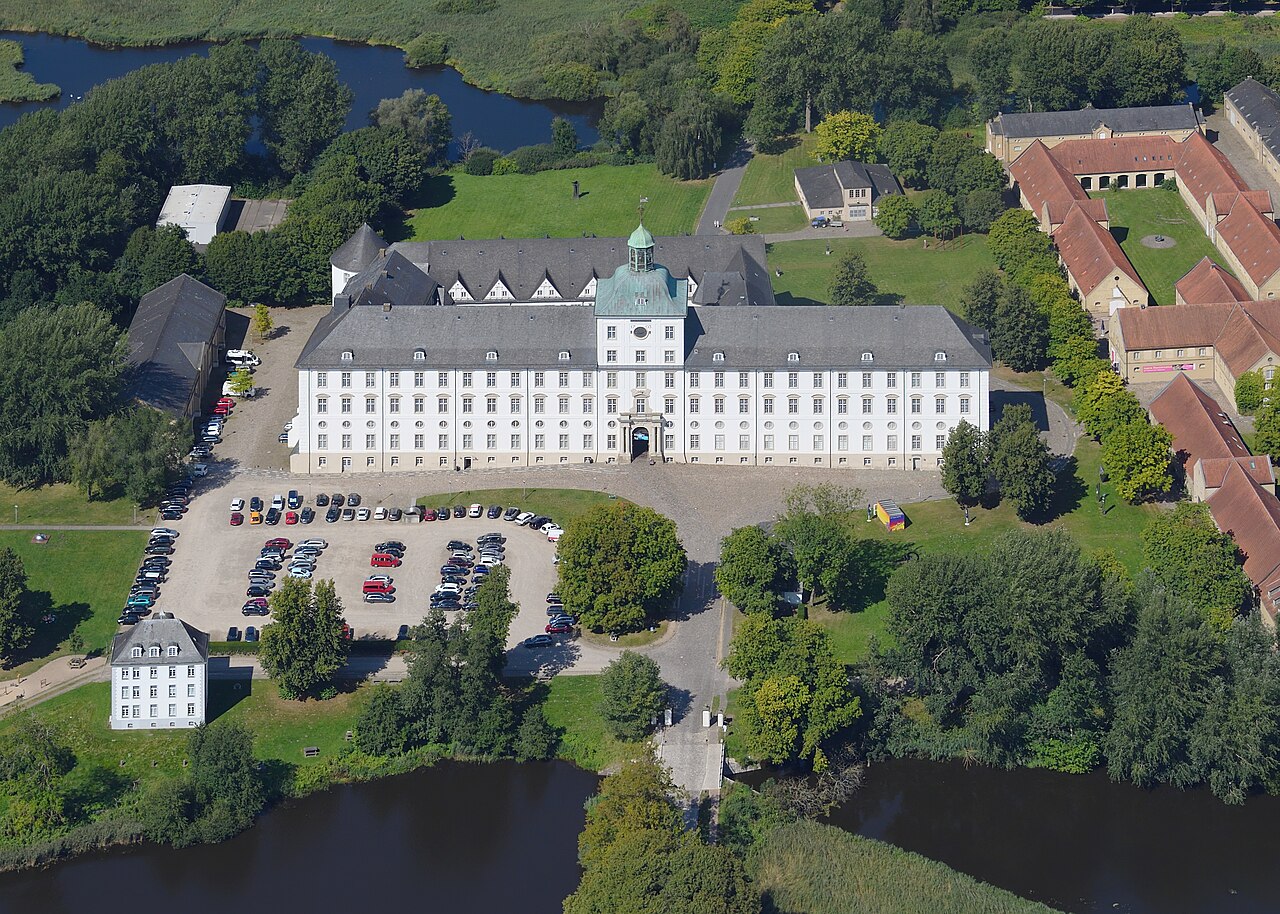
The block finally reached the restoration workshop at Gottorf Castle in Schleswig, home to the state's Museum of Archaeology. Conservator Tina Heintkes-Willers separated the vessels one by one from the surrounding earth. She speaks of truly special working days. By September 2026, all five objects had been fully uncovered.
The group includes bowls and cauldrons, some with fine decoration, and a well-preserved bronze strainer. Several vessels show ancient repairs: they were patched up so they could go on being used, a sign that they were valuable. The articles we consulted give neither their dimensions nor their weight.
Grave or hiding place?
Specialists date the objects to between the 3rd and 5th centuries AD, that is, between the Roman Imperial period and the Migration Period. Schleswig-Holstein was never part of the Roman Empire: these vessels are imports, which reached the Germanic peoples of the north through trade, exchange or gifts.
The big question remains: why were they buried? Elsewhere, cauldrons of this type were used as urns for cremations, placed in graves with the dead or hidden as a hoard. For Schaalby, nothing is settled: funerary offering or treasure put away for safekeeping, both hypotheses remain open.
A rarity on the Baltic
These cauldrons are known mainly from Scandinavia, along the Rhine and on the North Sea coast. In Schleswig-Holstein they are extremely rare. The only comparison cited is a Roman bronze cauldron discovered in 1869 at Burg, in the district of Dithmarschen.
For Angelika Abegg-Wigg, curator at the Museum of Archaeology at Gottorf Castle, the find is extraordinary for Schleswig-Holstein, and unique for the Baltic Sea region.
Where can you see them?
The first showing took place at the A. P. Møller School in Schleswig, during the Archaeology Day, on a Saturday in November 2026, one year after the discovery. A small exhibition was open there from 9 a.m. to 6 p.m., with films of the excavation, the block lifting and the restoration. It lasted only one day.
After that, patience will be needed. Gottorf Castle is being renovated. Once the work is finished, the vessels are due to move to Schleswig's Museum Island, where they are announced as one of the highlights of the new permanent archaeology exhibition. No date has been given so far.
Roman treasures of Germany on the Atlas
Roman tableware travelled far beyond the borders of the Empire. On the Atlas, discover the Hildesheim Treasure, a great Roman silver service found in Lower Saxony, the Hiddensee treasure, on a German island in the Baltic, and all our content on Germany.
 Hungary: 208 Celtic silver coins found 40 cm underground, beneath a future power substation in Szombathely
 Sutton Hoo: a new Anglo-Saxon grave, with brooch, knife and tweezers, found far from the royal mounds
 Havmanden wreck: a luxury shoe and manillas on the Danish ship of the 1683 mutiny